The score sheet is often the first thing to disappear on game night. A pencil rolls under the table, one player’s points are squeezed into a corner, and by the final round nobody can tell whether a number was a score, a bonus, or a correction. Farouk Book Store can help you assemble a simple paper kit that makes recording easier without pretending to replace the rules supplied with any particular game.
The goal is not a fancy tournament form. It is a reusable convention: decide what gets written down, give each player a consistent space, mark changes visibly, and keep the scorekeeper from having to remember the whole evening. Because casual games vary so widely, the kit should record information rather than reproduce a publisher’s rulebook or copyrighted scoring system.
Start with a recording convention, not a game template
Before choosing paper, decide what your group actually needs to remember. A quick, points-based game may need only player names, round numbers, and a running total. A longer evening may need separate columns for points earned, deductions, bonuses, and a final check. A game with teams needs team names and player initials; a rotating scorekeeper needs a clear place to continue from the last completed round.
Use one small legend at the top of the first sheet. For example:
- R means the round is complete.
- C means a correction was made and the original number remains readable.
- B means a bonus or agreed extra entry.
- — means a category did not apply that round.
These are your group’s recording marks, not official game terminology. Write the legend in plain language so a late arrival can understand the page without asking for a recap. If a game uses its own named categories, copy only the short labels your group needs for reference; do not turn the sheet into a reproduction of the game’s instructions.
A useful convention also answers the awkward questions before they arise: Does a blank mean zero or not yet recorded? Do you write deductions with a minus sign? Who confirms the final total? Agreeing on those details at the beginning prevents a disputed number from taking over the last five minutes.
Assemble three kinds of paper for three jobs
A practical kit has a working sheet, a quick-note layer, and a clean backup. They do not need to match. In the Farouk selection, Dreamy Thoughts Cute Aesthetic Sticky Notes can serve as temporary flags for questions or unfinished entries. Its catalog description lists a 3-by-3-inch pad with 50 adhesive sheets, so it is better for short prompts than for a full score grid. Use one note to mark “confirm round 4” rather than covering the score itself.
For a more visible running record, Purple Gradient Clouds Aesthetic Message Memo Notepad offers 4-by-6-inch non-adhesive paper with 50 sheets. That makes it a sensible choice for a compact score page: player initials across the top, rounds down the side, and a total column at the edge. Since it is loose memo paper rather than adhesive, it can be moved into a folder after the game or placed beside the board without sticking to the table.
A smaller adhesive option can help when several people are contributing. Beach Cute Aesthetic Sticky Note is listed as a 3-by-3-inch pad with 50 sheets. It can hold a player’s proposed tally or a question for the scorekeeper, but its compact size is a reason not to force a full multi-round ledger onto it. Treat it as a temporary input, then transfer confirmed numbers to the main sheet.
These examples are an editorial selection from the Farouk catalog, not a claim that Farouk manufactures every design. Check the current product listing for the details that matter to your setup, and choose a paper size that leaves room for handwriting. If you need a broader browse, visit the Notepads collection; for questions about availability or an order request, use Farouk’s contact page. The site’s bag prepares an email order request rather than a payment checkout, so inventory, taxes, and shipping should be confirmed.
Use a layout that survives interruptions
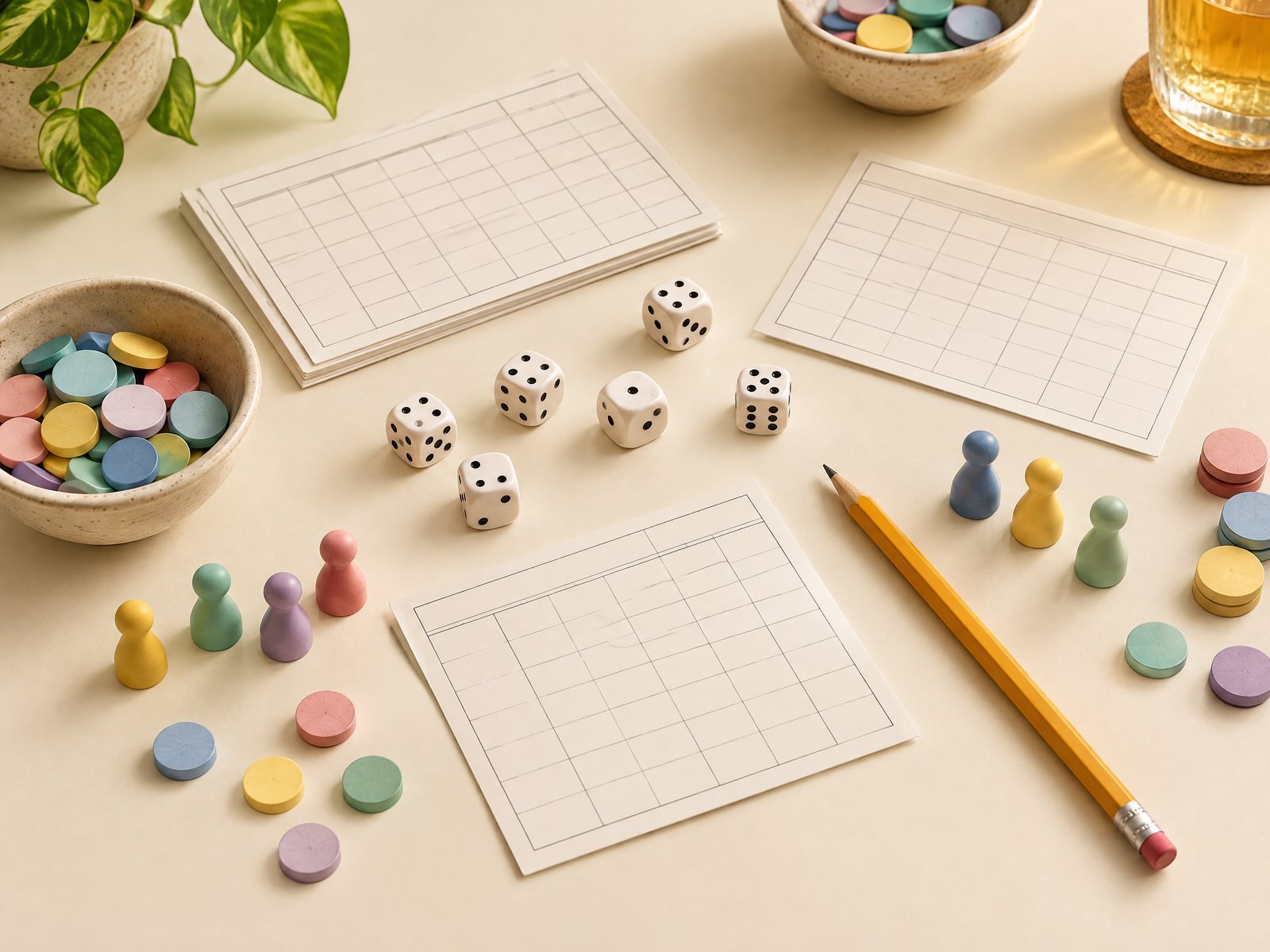
The most reliable casual layout is deliberately repetitive. Put the date and game title at the top, then list players or teams in a fixed order. Number the rounds down the left side. Give each player one column, and reserve the final column for a running total or a check mark. If categories matter, use a second sheet rather than shrinking every label until nobody can read it.
Here is a verbal layout you can draw in under a minute:
1. Header: date, game title, and scorekeeper’s initials. 2. Roster: player or team names in the order agreed at the start. 3. Round grid: one row per completed round. 4. Notes margin: questions, skipped rounds, or agreed corrections. 5. Final check: totals, tie status, and everyone’s confirmation.
Keep the notes margin separate from the number grid. A sentence such as “Alex’s bonus confirmed after replay” is useful context; squeezing it next to a number makes later reading harder. For a rotating scorekeeper, add a small box at the bottom reading “Next recorder” and leave it blank until the handoff. This prevents the pencil from silently moving between people while the table is distracted.
For team play, write both the team name and player initials. “Blue” may be obvious during the game but confusing when the page is reviewed later. If people change teams between rounds, draw a horizontal divider and restate the roster rather than relying on memory. A little repetition is cheaper than reconstructing the arrangement afterward.
Plan for errors, ties, and the games that do not fit
A score sheet fails when it assumes every round is clean. Build corrections into the convention. If a number is wrong, draw one line through it, write the replacement beside it, and add the C mark. Do not erase the original if the group may need to discuss what changed. If the correction affects a running total, recalculate that total instead of quietly changing only the final number.
A tie deserves its own line. Write “tie after final round” in the notes margin, then record the group’s agreed next step in neutral language: “additional round,” “shared result,” or “use game instructions.” The paper should document the decision, not invent a tiebreaker. If the game’s official rules specify a tiebreak process, consult those rules separately rather than copying them onto your homemade sheet.
For games with unusual scoring, use labels that describe your record rather than claiming authority. “Points recorded,” “tokens noted,” “penalty agreed,” and “round complete” are flexible phrases. Avoid printing a fixed set of categories if your group plays several games with different systems. A generic page with a notes margin will serve more evenings than a beautiful sheet built around one unverified format.
Watch for four predictable failure cases:
- Tiny writing area: Move from a 3-by-3-inch note to a 4-by-6-inch memo page or use one sheet per team.
- Lost totals: Add a running-total column and have the scorekeeper read it aloud after each completed row.
- Unmarked pauses: Put a circle around an incomplete round and finish it before starting the next one.
- Crowded table: Keep the active sheet on a clipboard, book, or clear corner and use sticky notes only for temporary questions.
The adjustment should solve the specific failure, not add decoration. If the issue is noise, use bold headings. If it is handoff confusion, add initials and a next-recorder box. If it is limited space, separate the round grid from the category notes.
At the end of the evening, spend two minutes closing the page. Confirm that every round is marked complete or clearly labeled incomplete. Add the final totals only after the last correction. Have players check their own entries when practical, then note “confirmed by group” with the date. This is a record of a shared activity, not a formal official result, so keep the wording factual and modest.
Store blank pages, a pencil, and any temporary notes together in a slim folder or envelope. Do not attach adhesive notes permanently to a borrowed game, a book, or a surface you do not own. If the group wants to remember the evening, add a separate line for the game played, who attended, and one original observation such as “the comeback began in round six.” Keep personal contact details and sensitive information off a sheet that may be passed around.
For the next gathering, reuse the convention but revise only what caused friction. Maybe the roster needs more space, the notes margin needs to be wider, or team initials need a key. A small paper system becomes dependable through these targeted edits, not through a complicated master form. For related everyday paper decisions, see How to Use Sticky Notes for Weekly Planning and Notepad vs Notebook: Choosing a Useful Everyday Format. If you want a broader desk setup, Stationery Retail Display Ideas for Compact Shelves offers another way to think about visible, usable paper.
Related reading: How to Use Sticky Notes for Weekly Planning, Notepad vs Notebook: Choosing a Useful Everyday Format, and How to Make a Daily To-Do List Without Overplanning.