If your weekly to-do list keeps becoming a crowded paragraph, try sticky notes for weekly planning instead. One note can hold one task, appointment, idea, or decision, so you can move pieces around as your week changes. This method is especially useful when you want a visible plan without committing every detail to a permanent page.
The goal is not to cover your wall with paper. It is to create a small, readable system that helps you decide what matters, when it fits, and what can wait. With a few minutes of setup and a short review at the end of the week, sticky notes can support schoolwork, work projects, household routines, creative plans, or a mixture of all four.
Choose a setup that matches your week
Start by choosing a planning surface. A notebook spread works well if you prefer privacy and portability. A desk, whiteboard, folder, or clear section of wall can work if you need to see the plan while moving through the day. Before placing notes, check that the surface is clean and that the adhesive is suitable for it. If you are unsure, test one note in a discreet spot rather than assuming it will remove cleanly.
Use a simple weekly layout. Draw or imagine seven columns from Monday to Sunday, then add a small area labelled “Later” or “Waiting.” You can also divide the week into three broad zones—early week, midweek, and weekend—if a daily grid feels too restrictive. The best layout is the one you will read quickly. Leave enough space between notes to move them without disturbing neighbouring tasks.
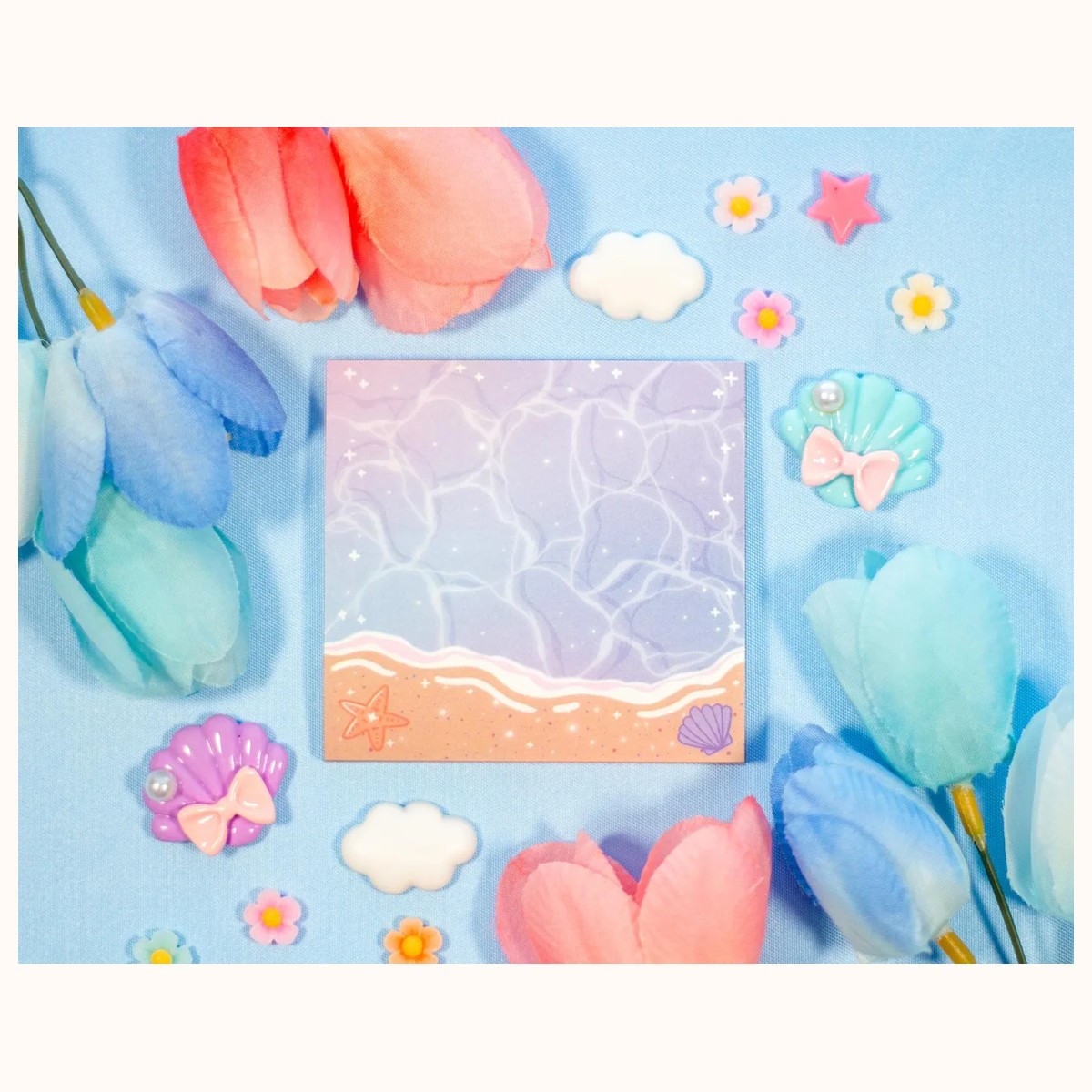
Select notes according to the amount of writing you need. A compact square note is useful for a short action such as “call dentist,” “send outline,” or “buy rice.” A larger note may be better for a multi-step project, but avoid squeezing an entire project plan onto a tiny square. For example, the Beach Cute Aesthetic Sticky Note is a 3 x 3 inch pad with 50 sheets, a practical size for short reminders, brief checklists, or a single next action.
If you like a more decorative desk, the notepads collection gives you a place to browse related paper goods. Choose appearance after function: a note should be easy to read at a glance, and a busy design should not make small handwriting difficult. If you need loose, non-adhesive paper for longer notes, verify the product description carefully; a memo pad is not automatically a sticky note.
Before the week begins, gather one writing tool and a small number of notes. Too many colours and shapes can turn planning into sorting. A useful starting rule is one colour for tasks, one for appointments, and one for personal or household items. You can add another colour for waiting items only if that distinction genuinely helps you make decisions.
Build the plan in three passes
Pass one: collect everything without scheduling it
Write a quick inventory of the week. Put one item on each note, using a verb and a clear result. “Finish presentation slides” is more useful than “presentation.” “Email Sam the revised budget” is more useful than “budget.” Keep recurring routines separate if they require separate actions, but combine tiny steps that always happen together.
Include fixed commitments, not just tasks. A dentist appointment, class, work shift, travel time, meal preparation, and a child’s activity all compete for time. Write appointments with their start time and location, if relevant. This prevents the common mistake of treating a full calendar day as if it has unlimited task capacity.
Then mark the notes that have consequences if they move. You might add a small star, a corner symbol, or a colour rather than writing a long explanation. Examples include a form due Wednesday, a payment deadline, or a meeting that requires preparation. Do not label everything urgent. If every note is urgent, the label cannot help you choose.
Pass two: sort by importance and timing
Place fixed appointments first. Next, add tasks that must happen before a particular event. Then place flexible tasks into open spaces. A useful decision question is: “What is the next visible action?” If “prepare for Friday meeting” feels too broad, split it into “read brief,” “draft three questions,” and “send agenda.” Each note should be small enough to move and specific enough to start.
Limit the number of major tasks per day. A day containing work, commuting, meals, and family responsibilities may realistically hold only one or two demanding tasks. Leave a little open space for interruptions. Your notes are there to help you make a plan, not to prove that you can fit an imaginary second day into Tuesday.
Use the “Later” area for good ideas that are not part of this week’s promise. This could include reorganizing a cupboard, researching a course, or starting a personal project. Moving an idea to Later is not abandoning it; it is protecting this week’s focus. Add a review cue, such as “consider next Sunday,” so the note does not disappear indefinitely.
Pass three: make the plan actionable
Read each note and ask three questions: Is the action clear? Is it assigned to a realistic day? Is the note placed where I will see it before the deadline? If the answer to any question is no, rewrite or move it now.
For a large project, stack notes in sequence rather than placing one oversized note across several days. For example:
- Monday: gather references
- Tuesday: draft the first section
- Wednesday: revise and request feedback
- Thursday: make final changes
- Friday: submit
This sequence exposes bottlenecks. If feedback is needed before Thursday’s revision, the schedule shows that dependency early. If the work cannot fit, you can move the deadline, reduce the scope, or ask for help before the last day.
Use notes during the week without creating clutter
At the start of each day, choose one “must move” note and up to two “should move” notes. Keep the daily decision small. When you finish a task, remove the note, move it to a completed area, or turn it over. Choose one method and use it consistently so that an empty space means something.
When new work arrives, do not immediately insert it into today’s column. Write it on a fresh note and ask where it belongs. Is it genuinely time-sensitive? Does it replace an existing priority? Can it wait until the weekly review? This short pause protects your plan from becoming a live inbox with no boundaries.
Use repositioning as a decision tool. If a task moves for the second time, stop and diagnose the reason. It may be too large, unclear, dependent on another person, or simply less important than it seemed. Rewrite “clean office” as “clear desk surface for 15 minutes” if the original feels too big. Change “ask for update” to “send a two-sentence follow-up email” if you are avoiding an ambiguous task.
For shared planning, write names or initials on tasks that involve another person. Add a waiting note when you have completed your part but need a reply. For example, place “waiting: Alex confirms delivery date” in a separate area. This stops you from repeatedly rewriting the same task and makes follow-up visible.
If notes lose their grip, curl, or fall, first reduce handling and avoid damp or dusty surfaces. Move the note to paper or a smoother planning surface, and use a fresh note if the original no longer stays in place. If notes are hard to read, use fewer words, larger lettering, or a colour reserved for headings. If the layout feels visually noisy, remove decoration before removing useful tasks. A plain, readable plan is more helpful than a beautiful one you avoid opening.
Keep sensitive information off a shared wall. Use neutral wording for private appointments, financial matters, or personal details, and store the full information elsewhere. A visible weekly plan should show enough to guide action without exposing information to everyone who passes by.
Review, reset, and improve the system
Set aside ten minutes at the end of the week. Move finished notes to a completed area, then look at everything unfinished without judging yourself. There are only a few useful destinations: schedule it for a specific day, break it into a smaller next step, delegate or request information, place it in Later, or remove it because it no longer matters.
Look for patterns rather than perfection. Did one type of task repeatedly move from day to day? Was the note too vague? Did you underestimate travel or preparation time? Did an appointment leave no recovery time around it? Your answers can improve next week’s layout more than adding another colour system.
A practical reset might look like this:
1. Remove completed notes. 2. Rewrite any vague or oversized tasks. 3. Move waiting items into a follow-up area with a date. 4. Carry forward only tasks that still support your current priorities. 5. Add fixed commitments for the new week. 6. Choose the week’s top three outcomes.
Keep a short “done” strip if motivation matters to you. Seeing completed notes accumulate can make invisible work visible, especially for household administration or long projects. At the same time, do not treat the strip as a permanent archive. Recycle or store old notes according to your preference once the review is complete, and keep the active board easy to scan.
If you prefer a checklist format, a purpose-designed option such as the Straight-a-student Check List Cute Aesthetic Sticky Notes can support small study or errand lists. Use it for a cluster of related actions, then place the note in the relevant day. If you want a more portable approach, keep a few notes inside a notebook and transfer only the active items to your weekly layout.
Finally, remember that sticky notes are a flexible planning aid, not a complete calendar or reminder system. Use a calendar for appointments and alarms for time-critical events; use sticky notes to make actions visible and movable. For questions about a product, page details, or suitability for your planning setup, consult Farouk Book Store’s contact page. Start with one week, a few notes, and a layout you can understand in seconds. Then adjust the system based on what your real week teaches you.
Related reading: How to Choose Stickers for Journals and Planners · 2026 Stationery Trends: Color, Texture, and Joy · How to Build a Personalized Gift Bundle