A notebook can be beautiful and still be frustrating if it does not match the way you write. This notebook size guide helps you choose by use rather than by appearance alone: how much space you need, where the notebook will go, and whether you will write at a desk, on a train, or while standing. The aim is not to find one universally “best” format, but to choose a page that makes your intended habit easy to keep.
Before shopping, write down three details: your usual entry length, the bag or pocket that will carry the notebook, and the largest thing you expect to record. A few lines of daily reflection call for a different page than a full travel itinerary, a running packing list, or sketches beside notes.
Start with the job your notebook must do
The most useful size decision comes from the notebook’s job. For short lists, a small format keeps the task visible and prevents a page from feeling unnecessarily empty. It works for errands, daily priorities, quick observations, and a few lines of gratitude. If your list regularly grows beyond one page, however, the “small and portable” choice may become a nuisance: you will turn pages often, split one idea across spreads, or squeeze words into the margins.
For journaling, consider both entry length and writing style. A brief, consistent check-in can fit comfortably in a compact book. A reflective journal with paragraphs, pasted mementos, headings, or doodles benefits from a wider page. Leave room for the way you actually journal, not only the words you hope to write. If you frequently add tickets, captions, or decorative elements, allow more page area than a plain-text diary would need.
Travel notes usually need a middle ground. You may want room for a daily plan, addresses, meal ideas, expenses, and impressions, but you also need to carry the notebook through changing locations. A page that accommodates a two-column layout—such as “plan” and “what happened”—can be more useful than a larger page used without structure. For flights, museum visits, or walking days, check whether the notebook can be opened and written in with one hand.
A simple test is to draft a representative page on loose paper. Draw the headings you expect to use, such as “morning,” “route,” “cost,” and “notes.” If the writing feels cramped on a sheet of the proposed size, go up one format. If most of the page remains blank and portability matters, go down or choose a slimmer book.
Compact formats: lists, pockets, and quick notes
Compact notebooks are practical when the main requirement is availability. They can slip into a small bag, coat pocket, or desk drawer and are easy to reach for a grocery list, idea, reminder, or short observation. They also work well as a dedicated insert alongside a larger journal: one book for capture, another for longer entries.
Choose compact when:
- Your entries are usually a few lines or a short checklist.
- You want to carry the notebook alongside a phone, keys, or wallet.
- You prefer finishing a page quickly rather than seeing a large blank area.
- You need a low-commitment place for temporary notes that can later be transferred.
The trade-off is writing capacity. A compact page may not leave enough room for a detailed itinerary or a long reflection, and a thick cover or binding can make the usable writing area feel even smaller. Test the inside margins as well as the outside dimensions. If you write with a broad pen or your hand rests near the edge, a narrow page can feel restrictive.
For short lists that do not need a bound notebook, a 3 x 3-inch adhesive pad can be a better tool. The Straight-a-student Check List Cute Aesthetic Sticky Notes has a checklist-style layout and 50 sheets, making it suited to tasks that need to stay visible on a desk, planner, or notebook. Because it is a sticky-note format rather than a permanent journal, use it for action items, temporary packing reminders, or a “today” list—not for archival travel memories.
A common compact-format problem is losing context. A note such as “call hotel” may make sense for one day and be confusing later. Add a date, place, or one extra identifying word. If the notebook is for travel, reserve a small line at the top for the destination and date before recording details.
Medium and roomy formats: journaling that has space to breathe
A medium notebook is often the most flexible choice for everyday writing. It can handle a daily entry, a running list, a meeting note, or a simple travel page without being as demanding to carry as a large journal. It is a strong option when your routine changes: some days require only a paragraph, while others call for several sections.
Roomier notebooks are especially useful when your page needs structure. You can divide a spread into schedule, notes, expenses, and memories; leave a margin for follow-up tasks; or combine writing with sketches. More area also makes revision easier. Instead of crossing out a changed plan or compressing a late thought into a corner, you can keep the page legible.
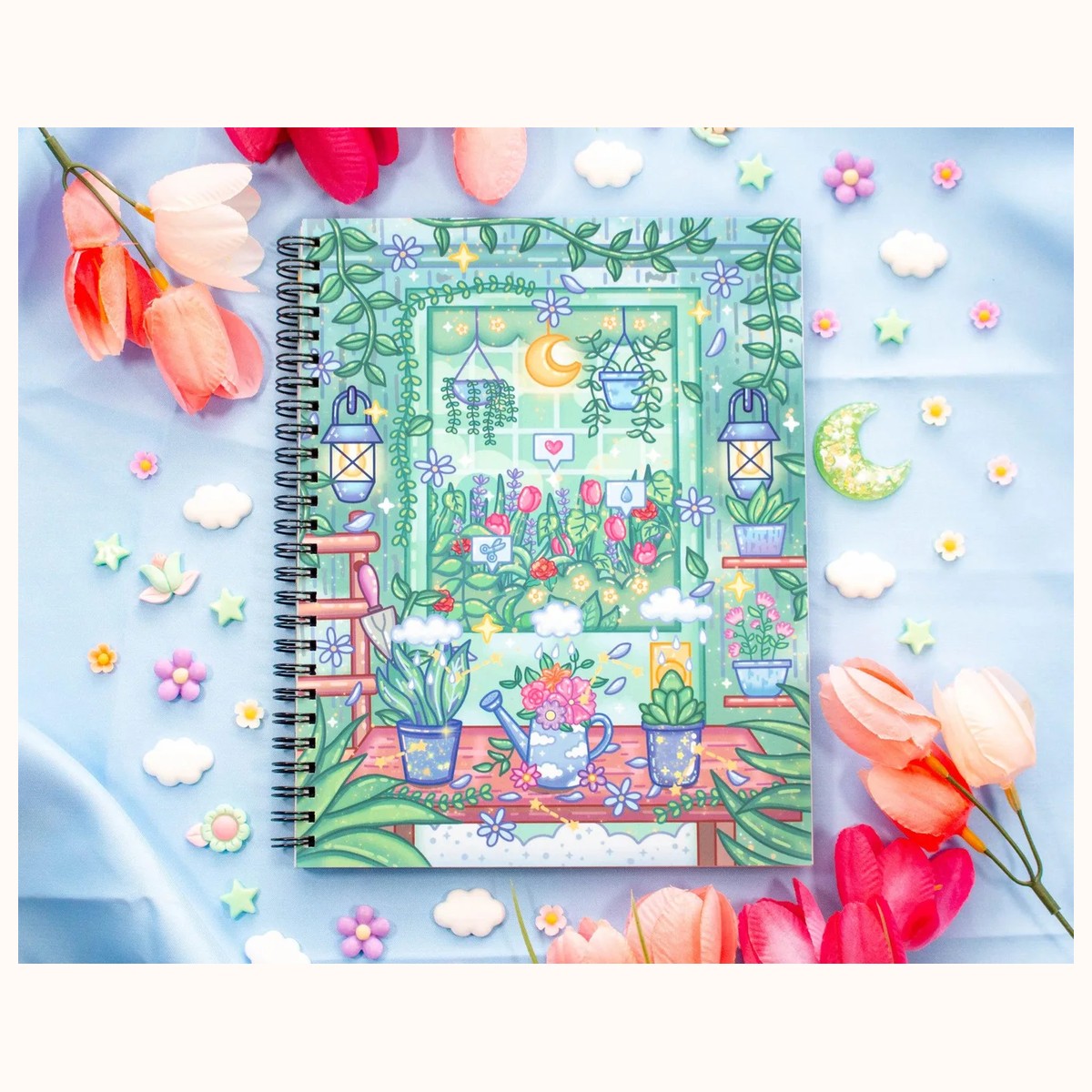
The Botanical Bliss Spiral Lined Notebook (7x9") is a concrete example of a roomy everyday format. Its listed 7 x 9-inch size provides a substantial writing area, and its college-ruled lined pages suit paragraphs, lists, and dated entries. The spiral binding is designed to let pages lie flat, which is useful when writing at a desk or filling in a two-page travel spread. If you usually write in very large lettering, add sketches, or carry many sections in one book, this type of format gives you more forgiveness than a pocket notebook.
Roomy does not automatically mean better. A larger notebook can stay at home because it is inconvenient to carry, or it can encourage overplanning when a short list would do. Before choosing one, measure the inside of your everyday bag, not just the exterior. Account for a case, charger, water bottle, or other items that compete for space. If the notebook fits only when the bag is empty, it is not a practical travel choice.
If pages wave slightly after unpacking or storage, place the closed notebook under a light, even weight for a while and handle it gently; do not force the binding flat. For any book, check the product description for the stated page dimensions and page ruling, then decide whether those details match your pen, handwriting, and layout.
Build a travel setup that survives real days
Travel changes the size decision because your notebook has to work in motion. A useful setup separates capture from storage: keep a small list tool immediately accessible, and use a larger notebook for notes worth keeping. This prevents a large journal from being opened for every tiny reminder while preserving space for meaningful entries.
Before leaving, create a repeatable page layout. For example, use the top line for destination and date, the left side for fixed plans, and the lower half for observations. Leave a small box for expenses or follow-up actions. A consistent layout reduces the amount of page space spent deciding where information belongs. It also makes it easier to find a reservation detail or a place name later.
Think through these practical situations:
- Writing while standing: choose a size that can be supported by one hand, or use a firm back and a layout with short lines.
- Public transport: avoid a format so wide that it bumps neighboring passengers or cannot be opened safely.
- Rain or spills: use a cover or pouch and keep the notebook inside a bag when conditions are uncertain; do not assume paper is moisture-proof.
- Souvenirs and tickets: if you plan to attach items, choose extra page room and consider how added thickness will affect closing and carrying.
- Shared planning: a larger format is easier for two people to read, but a small personal log may be better for private observations.
A practical companion is a pencil case or pouch that matches the notebook’s footprint. For example, the Stacked Books Cute Aesthetic Pencil Case is listed at 8 x 5 inches and can organize pens and small accessories. Compare its dimensions with your notebook before treating it as a matched set; a pouch that is too short may bend a pen or prevent the notebook from sitting flat beside it.
For loose travel references, 3 x 5-inch cards can fill the gap between a pocket note and a bound journal. The Starry Clouds Note Cards are listed in that classic card size, with one lined side and one unlined side. Use one card for a packing checklist, route notes, or a phrase list, then store completed cards in a notebook pocket. Since loose cards can separate from the main record, write the date and destination on each one.
If you repeatedly abandon a notebook halfway through a trip, troubleshoot the system rather than blaming your discipline. It may be too large to reach quickly, too small for your handwriting, or divided into sections that do not match the trip. Try carrying only one pen, simplifying the daily template, and moving long-form reflection to a larger book at the end of the day. The best size is the one you can open, understand, and close without friction.
For category browsing, visit Farouk Book Store’s Journals & Notebooks collection. Product dimensions and availability can change, so confirm the current listing before buying; for questions about a particular item or fit, use the store’s contact page.
Related reading: How to Choose Stickers for Journals and Planners · Vinyl vs. Paper Stickers: A Complete Guide · 2026 Stationery Trends: Color, Texture, and Joy