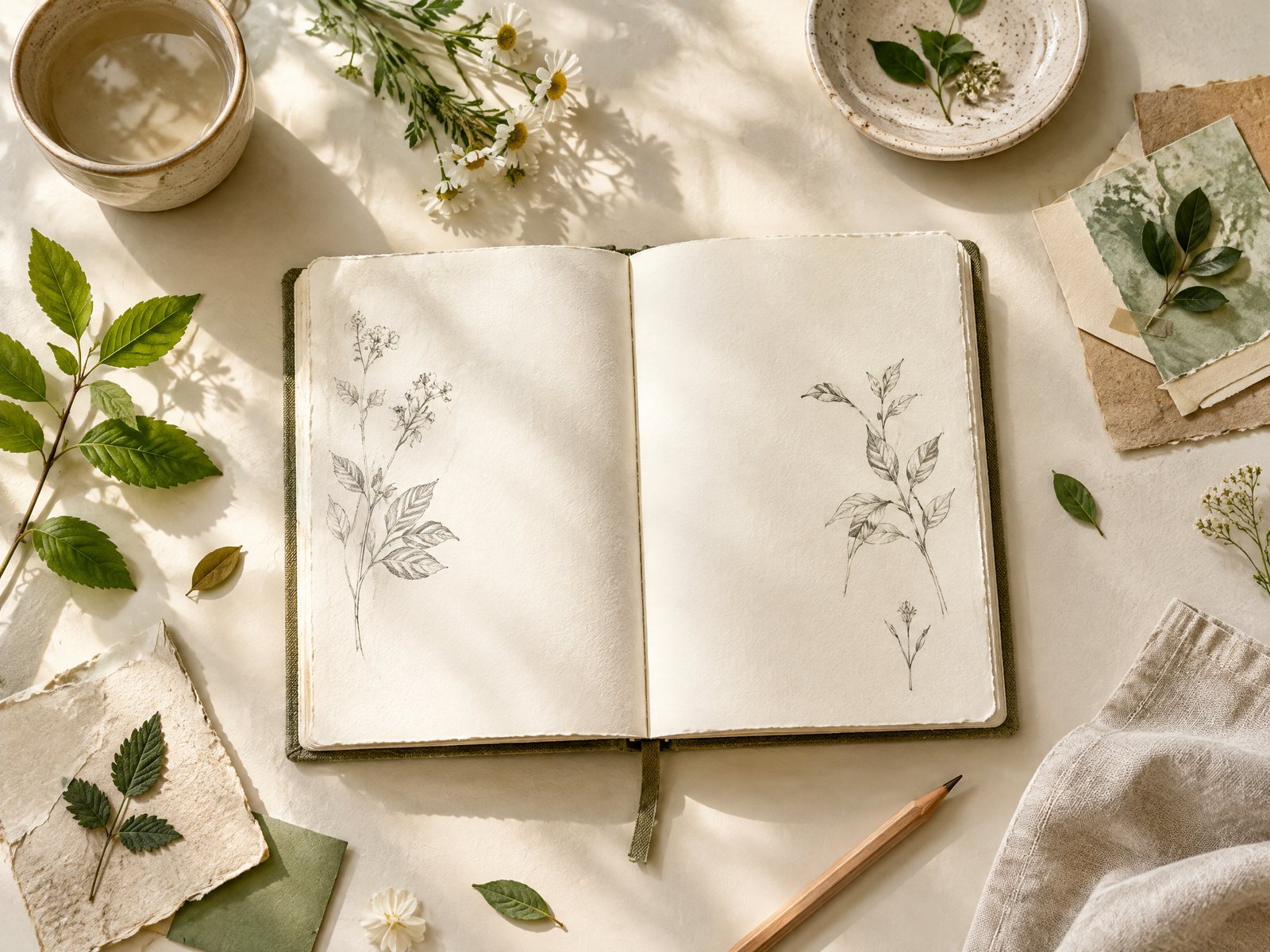
A home garden can change between two ordinary glances, yet a quick memory rarely captures what you actually saw. One day there is a new bud, a fallen leaf, or a visiting bird; a week later, the detail has blurred into “the plants looked different.” Farouk Book Store’s stationery selection can give those small visits a consistent paper home. The goal is not to become a botanist or turn a notebook into a plant-care manual. It is to make a faithful record of your own view: what was visible, when you noticed it, what you sketched, and what you still wonder about.
A useful observation page should be easy to start and easy to compare. It needs enough structure to prevent a blank-page pause, but enough room for an unexpected detail. With a date, a few visual notes, a rough sketch, and one open question, an ordinary garden becomes a sequence of moments rather than a collection of vague impressions.
Start with a repeatable page, not a perfect garden journal
Choose one page or two facing pages for each visit. At the top, write the date and a simple location label such as “back step,” “patio pot,” or “side bed.” A location label is more useful than a grand garden name because it tells your future self where you were standing. If you observe at different times, add “morning,” “late afternoon,” or another plain time description. You are recording conditions as you experienced them, not claiming a controlled test.
Divide the page into four modest areas:
- Seen: a short list of visible details, such as “two pale petals,” “dark soil at the pot edge,” or “three small insects on one leaf.”
- Shape: a quick sketch of one leaf, stem, flower, shadow, or arrangement.
- Words: a sentence about color, texture, sound, or movement that a drawing may not capture.
- Question: something to look for next time, phrased without assuming an answer.
This layout makes comparison possible while leaving space for a surprise. Do not fill every box merely to make the page look complete. If there was no obvious sound, write “quiet” or leave that field out. A record of what you did not notice is more honest than decorative filler.
For a notebook with a botanical visual cue and enough writing room, the Botanical Bliss Spiral Lined Notebook is one possible starting point from the Farouk selection. Its listed 7 x 9 inch format, spiral binding, and lined pages suit written notes and small diagrams. Treat those details as the product listing describes them; Farouk is presenting an editorial selection, not claiming to manufacture every catalog design.
Use sketches to preserve relationships and scale
A garden sketch does not need to identify a species or look suitable for display. It can show where something appeared in relation to a pot rim, fence line, stone, or neighboring leaf. Begin with one anchor: draw the edge of the container or a short section of the bed. Then add the feature you want to remember. A few directional lines can show that a stem leaned toward a window or that several leaves clustered on one side.
Try three sketch types on different visits:
1. Outline sketch: trace the broad silhouette of a leaf, flower head, or group of stems. Use this when shape is the most noticeable feature. 2. Position sketch: draw a tiny map of the area, marking where the feature sits relative to a fixed object. Use this when placement matters more than detail. 3. Close detail: enlarge one small surface or edge and label only what you can see, such as “speckled,” “smooth,” or “curled.” Use this when a small visual difference caught your attention.
Add a simple size cue when it helps: “about the width of my thumbnail,” “shorter than the pot rim,” or “spans two pencil lengths.” These are personal reference points, not measurements for a scientific report. Avoid turning a sketch into an identification exercise unless you have a reliable source and the confidence to distinguish observation from interpretation.
A decorative paper element can help mark a section without taking over the record. The Botanical Bliss Cute Art Print, listed as a 5 x 7 inch single-sided print, could be kept beside the notebook as a visual divider or inspiration card rather than cut up and attached to every page. That keeps the actual observations legible and preserves the distinction between an editorial stationery choice and what your garden showed you.
Ask questions that make the next visit better
The strongest questions are small, visible, and answerable by another look. Instead of “Why is this plant unhealthy?” try “Is the pale edge still visible next time?” Instead of “Will this flower grow?” write “Which direction is the new stem facing?” These questions do not diagnose a plant, promise an outcome, or turn a casual record into professional advice. They simply give your next visit a reason to pause.
Build a rotating question bank so every entry does not sound the same:
- Change: What looks different from the last page?
- Position: What is nearest the feature I sketched?
- Pattern: Did I notice the same color or shape anywhere else?
- Activity: Was there movement, sound, or a visitor I had not noticed before?
- Absence: What expected detail was not visible today?
- Attention: What would I like to look at for thirty seconds longer?
Limit yourself to one or two questions per entry. Six questions can make a short visit feel like homework. If a question cannot be answered by looking, listening, or making a new sketch, revise it. “Is this definitely species X?” demands information you may not have; “What features could I compare with a trusted reference later?” accurately describes the next step without asserting a conclusion.
You can use small removable notes for questions that need to travel with you, then copy only the useful prompt into the notebook. The Pastel Academia Note Cards are listed as 3 x 5 inch cards with one ruled side and one blank side, a practical format for writing a prompt on one side and drawing a tiny observation box on the other. Keep names, addresses, or other private information out of pages you plan to share.
Make the system survive ordinary interruptions
A good observation practice has to work on a busy week, in changing weather, and after a visit when you only have five minutes. Keep the notebook where you are likely to remember it, but do not place it somewhere damp or exposed to dirt. Store a pencil or pen with it. If the notebook is in a different room from the garden, create a temporary note on a card and transfer it later with the original date; do not rely on memory to reconstruct the scene.
Use a “minimum entry” for rushed days: date, location, one visible detail, and one question. Use a “full entry” when you have time: add a sketch, sensory description, and comparison to the previous page. Both count. The system fails when every page is expected to be elaborate, because a missed visit becomes evidence that the whole project is too demanding.
Watch for a few common failure cases:
- The page becomes a catalog of plant names. Replace labels with what you actually saw. A name can be added later only if it matters to your record.
- Every sketch is a tiny portrait. Switch to a position map or silhouette so relationships remain visible.
- The questions turn into care instructions. Rephrase them as observations; seek qualified local guidance separately if you need plant-care help.
- Decorations crowd out evidence. Reserve a narrow margin for a motif, tape, or color mark and protect the main writing area.
- Different pages use different scales. Add a recurring anchor, such as the pot rim or a two-inch line, so comparisons are less confusing.
If the format feels right, browse Farouk’s journals and notebooks collection for a page surface that fits your writing habit. Before ordering, check the current product listing for its available details. The site’s bag prepares an email order request rather than functioning as a payment checkout, so inventory, taxes, and shipping should be confirmed instead of assumed. For questions about the shop or its catalog, the About page and Contact page are better places to verify current information than a guess in your notebook.
After a month, review the pages without grading them. Look for recurring colors, repeated locations, details you once missed, and questions that changed. You may discover that the most valuable entry is not the prettiest one but the page that made you look twice. A date, a rough line, and an honest “I am not sure yet” can be a complete record of an ordinary garden moment.
Related reading: Continue with How to Start a Reading Journal You Will Actually Use, Reading Journal Prompts Beyond Ratings and Summaries, and Notebook Size Guide for Journaling, Lists, and Travel.