A familiar book can feel oddly new when you return to it: a scene you once hurried through now catches you, while a line you remembered perfectly no longer carries the same weight. The problem is how to notice that change without covering pages in permanent notes, building a rating spreadsheet, or reducing a rich reread to a summary. Farouk Book Store’s bookmark selection offers a simple physical approach: use two removable memory markers, one for the earlier reading and one for the current one, then let their positions create a conversation.
This is not a system for judging whether a book is “better” than you remembered. It is a small, repeatable way to hold two versions of your response at once. The markers do not need to explain the entire book. They only need to point to moments worth revisiting: a passage that now feels tender, a character you understand differently, or a detail you completely missed before.
Start with two different jobs, not two ratings
Before opening the book, give each bookmark a distinct role. The first represents memory: what you recall being important, surprising, funny, difficult, or beautifully written. The second represents the present reread: what is making you pause this time. Avoid labels such as “good” and “bad.” They invite a verdict and make a reread feel like an exam.
A useful pair might be:
- Then: a place you remember carrying away from the first reading.
- Now: a place that has become newly meaningful, confusing, or vivid.
Write those words on a separate slip of paper, not on the bookmarks themselves, if you want to keep the markers reusable. You can also assign colors: a soft blue for remembered impact and a muted peach for current attention. The color distinction should be quick to recognize at the edge of a page; it does not need a decorative theme.
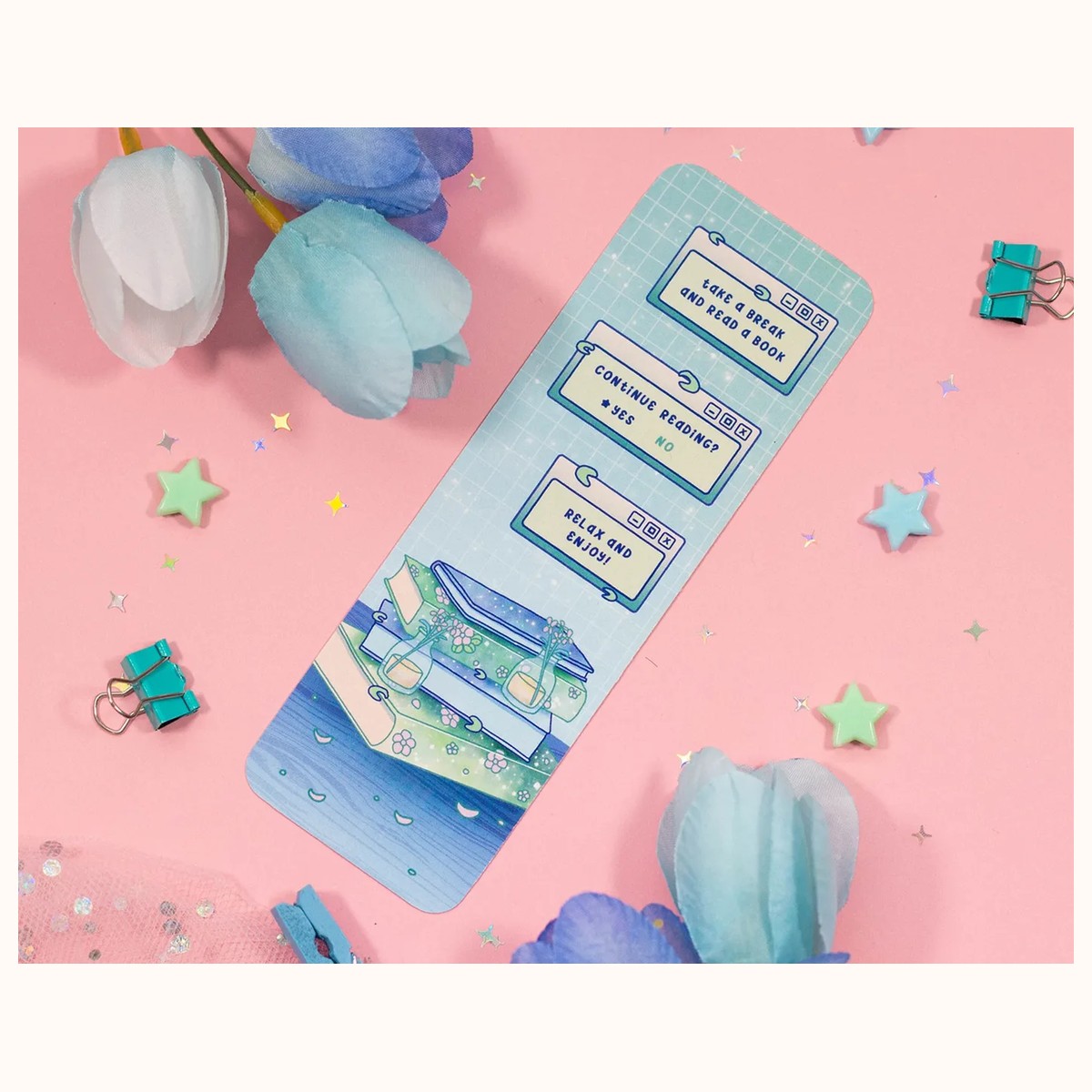
Choose markers with a slim profile so the book remains comfortable to hold. In the Farouk edit, the Stacked Books Cute Aesthetic Bookmark is an intuitive “Then” marker for a reader returning to a much-loved novel. Its approximately 2-by-6-inch glossy cardstock format is described as double-sided, with rounded corners. That makes it visually easy to distinguish without adding a complicated process. Product details can vary by listing, so use the catalog description as your practical reference rather than assuming every bookmark has the same construction.
For the “Now” position, the Starry Clouds Cute Aesthetic Bookmark gives you a contrasting soft visual cue. It is also listed at approximately 2 by 6 inches, with double-sided printing and rounded corners. Farouk is presenting an editorial selection here, not claiming to manufacture every design in the catalog; choose the item because its look helps you remember the role you assigned it.
Place markers at moments, not at chapter boundaries
The most revealing placements are often small and inconvenient. A chapter ending can be useful, but it may simply reflect the book’s structure. A sentence halfway through a scene can tell you more about your changing attention. When you feel the urge to say, “I did not notice that before,” place the present marker there. When your memory says, “This was the part I always talked about,” place the earlier marker at the remembered location, even if you cannot yet explain why.
Do not stop to write a paragraph every time. Use a three-second decision:
1. Did this moment connect to a specific memory of the first reading? 2. Did my reaction differ from what I expected? 3. Would I want to find this page again after finishing?
If the answer is yes to any one question, place or move the appropriate marker. A marker is a pointer, not a demand to interpret. Keeping the threshold low prevents the exercise from taking over the reading itself.
There is also value in leaving the marker at a moment that resists explanation. Perhaps a conversation now feels more uncomfortable, but you cannot identify the reason. Perhaps a supposedly minor object has become strangely prominent. Mark the uncertainty rather than forcing it into a polished insight. On a later pass, that unresolved spot may sit beside a clear pattern.
The Bookmarks collection is useful when you want to compare shapes and visual moods before deciding which two cues will be easiest to distinguish. A playful design can suit a light reread; a quieter one may disappear less into a densely printed page. The choice is about retrieval and recognition, not about matching a book’s cover.
Keep the comparison removable
Memory changes as you reread, so a fixed annotation can become misleading. If you write directly in the margins, your first interpretation remains physically louder than your later one. Removable markers preserve the option to revise. Moving a bookmark is not “losing” evidence; it reflects the fact that your attention has moved.
Try a two-pass rhythm. During the first pass through the book, place only the two markers. Resist adding tabs, stars, or full notes. At the end of each reading session, look at the marker positions and write no more than one short phrase on a separate sheet: “expected,” “newly tender,” “missed the setup,” or “still puzzling.” These are retrieval handles, not a formal rating template.
On the second pass, or after you finish, line up the phrases in reading order. You might see that your remembered moments cluster near the ending, while your current attention gathers around early choices by a character. That contrast is more interesting than an overall score because it shows where your reading lens has shifted. It can also reveal a practical failure: perhaps you placed “Now” markers too freely and ended with half the book flagged. If so, reset. Keep the three strongest locations and remove the rest.
Another common failure is using two markers that look nearly identical. In a dim room or a crowded book, you may forget which one means what. Change the rule rather than blaming your memory. Choose one visibly different design, add a small removable paper band to one marker, or keep the “Then” marker at the front cover while the “Now” marker travels. The best system is the one you can operate without consulting instructions.
If a glossy bookmark catches on a page edge, turn it so the rounded corner leads, and avoid pushing it deep into a tightly bound section. The catalog descriptions for the examples above mention rounded corners intended to reduce snagging, but ordinary books and handling conditions differ. A marker should help you return to a page, not put pressure on the binding. If the book is borrowed, keep every extra element loose and removable.
Finish with a small conversation between readings
When you reach the end, do not immediately turn the markers into a comprehensive review. Instead, compare three things: what you remembered, what changed, and what remained stable. You might find that the plot has faded but the atmosphere remains precise. You might remember a character as decisive and now notice how often they hesitate. Or you may discover that the scene you expected to outgrow still lands in exactly the same place.
A compact closing note can use three original prompts:
- My earlier self seemed to notice…
- My present self kept returning to…
- The distance between those responses is…
These prompts are intentionally unfinished. They make room for a phrase, a question, or a contradiction instead of requiring a summary. Keep the response private if the memory feels personal. A reread does not become more valid because it is shared, and no one else needs access to the pages you marked.
You can store the two bookmarks together with the separate comparison slip, then reuse them for another book. If you want a third marker, add it only for a clearly different purpose, such as a detail you want to research later. Three roles are usually enough; beyond that, the edge of the book can become a crowded legend rather than a reading aid. For a related practical idea, see how to use reading log bookmarks to track your books, but keep this memory-marker method separate from a completion log: the aim here is changed response, not coverage.
The Farouk edit makes this kind of rereading tangible through small, decorative objects that can move with the page. A Sunset Music Player Cute Aesthetic Bookmark could serve as the present marker if music, rhythm, or a particular atmosphere is part of what you notice. Its listing describes an approximately 2-by-6-inch glossy cardstock bookmark with rounded corners and double-sided artwork. The design is a cue for your private system, not a claim about what the book means.
That distinction keeps the practice honest. A bookmark cannot prove what your former self felt, and a current reaction does not erase an earlier one. It simply gives both responses a place to wait. When you open the book again months later, the markers can begin a new conversation: not “Which reading was correct?” but “What can I see now that I could not see then?”
If you need help selecting a format or checking a current item, contact Farouk Book Store.
Related reading: How to Start a Reading Journal You Will Actually Use, Reading Journal Prompts Beyond Ratings and Summaries, and Bookmark Material Guide: Matching the Marker to the Book.