You have found a stationery item that looks right, but one detail is still uncertain: will it fit the planner pocket, is the pad adhesive, or does the charm attach the way you expect? A vague message such as “Can you tell me more about this?” makes the answer harder to give. Farouk Book Store shoppers can get to a useful answer faster by naming the item, recording the facts that matter, and attaching a restrained photo when a picture genuinely explains the question.
This is not a returns-policy guide or a promise about stock, shipping, or order terms. It is a practical way to describe a catalog question so the shop can identify the right listing and respond to the right uncertainty. Treat Farouk as a shop with an editorial selection: product information belongs to the individual listing, and any availability or order detail should be confirmed with the store.
Start with the exact item, not only its appearance
Begin by copying the product title as it appears on the page. Add the relative product URL if you are writing from the website. A motif such as clouds, books, or a computer may appear across several formats, while the title and URL point to one specific listing. If you are comparing options, label each one separately rather than sending a collage and asking which item you mean.
Next, look for the SKU or other item identifier displayed by the listing, cart, or store correspondence. Include it exactly as shown, including letters, numbers, dashes, or capitalization. Do not invent a SKU from the product slug, price, or a guessed sequence. If no SKU is visible, say “SKU not shown on the page” and provide the full title and URL instead. That is more useful than converting a creative product name into an unofficial code.
A compact question header can look like this:
- Product: Blue Computer Sticker Sheet | Cute Stickers, Planner Stickers
- URL: `/products/blue-computer-sticker-sheet-cute`
- SKU: Not shown on the page
- Question: Is the 4 in x 6 in measurement the size of the entire sheet, and are the individual stickers sized separately anywhere in the listing?
That wording preserves what the listing says without pretending that an unstated detail is known. The Blue Computer Sticker Sheet is described as one 4 in x 6 in sheet containing 23 stickers, but the individual sticker dimensions are not supplied in the catalog description. Asking about that missing detail is clearer than estimating it from a product image.
If you are not sure whether two pages show the same item, include both URLs and explain the difference you noticed: title wording, motif color, format, or listed category. Avoid “the blue one” when several blue items could fit that description. Exact naming reduces the chance that a reply addresses a neighboring product.
Measure the decision you are trying to make
A measurement is useful only when it answers a real fit question. Before contacting the store, identify the place or task that creates uncertainty. Are you checking whether a bookmark will sit inside a paperback without protruding? Are you making room in a planner pocket? Are you deciding whether a memo pad leaves enough writing space? Write down the opening, pocket, or surface measurement first, then compare it with the catalog’s stated dimensions.
For example, the Stacked Books Cute Aesthetic Bookmark is listed at approximately 2 in x 6 in, with rounded corners and glossy cardstock. If your concern is a particular book, measure the page height and the margin available above the text block. Then ask a narrow question: “Is the approximately 6-inch height measured from the top to the bottom of the bookmark, excluding any rounded-corner variation?” That is more answerable than “Will it fit my book?” because it identifies the dimension and the possible source of variation.
Use the same discipline for writing space. A 3 in x 3 in sticky note and a 4 in x 6 in memo pad are not interchangeable merely because both are paper goods. The Purple Gradient Clouds Aesthetic Message Memo Notepad is described as 4 in x 6 in with 50 sheets, and its pages are not adhesive. If you need a note that attaches to a page, ask about adhesion directly; do not infer it from the word “memo.” If you need more room for a message, ask whether the listed dimensions describe the page itself or the pad’s outer edge.
A strong measurement note includes four pieces:
1. The catalog measurement, copied with its unit and “approximately” wording when applicable. 2. Your measured space, such as a 6.25-inch pocket or a 5.75-inch page height. 3. The tolerance you can accept, such as “up to 0.25 inch beyond the pocket is not workable.” 4. The missing fact, such as thickness, individual-piece size, adhesive backing, or whether a clasp adds to the overall length.
Do not convert an approximate dimension into a guarantee. Handmade or printed pieces can have small variations, and a photograph can make an item look larger or smaller than it is. If the decision depends on an exact fit, ask for confirmation rather than relying on visual scale.
Take a privacy-conscious photo that answers one question
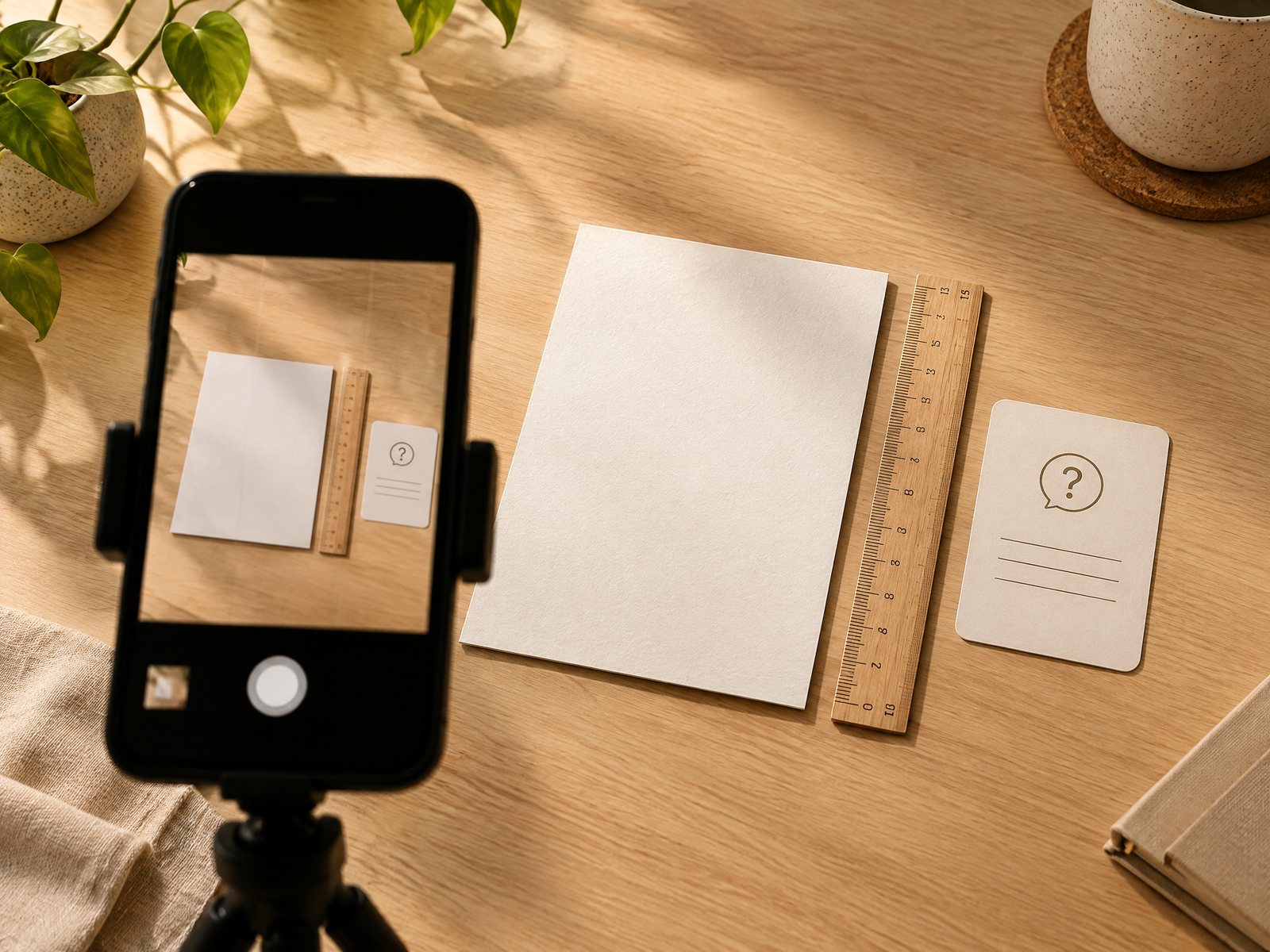
A photo helps when it shows a physical detail that text cannot establish: a scale reference, an unclear edge, a packaging label, or the difference between two similar items. It is not necessary to photograph your entire desk, planner, home, or personal correspondence. Frame only the item and the relevant detail.
Use a neutral surface and a familiar scale reference such as a ruler. Keep the ruler in the same plane as the object, with the zero mark visible. Photograph straight on for a flat sheet or card; use a second angled view only if thickness, a clasp, a protective film, or a raised edge is the question. Avoid using a hand as the only scale reference because hand size varies and can obscure the item.
Before sending the image, check its background carefully. Crop out names, addresses, phone numbers, order numbers, barcodes tied to your account, children’s faces, private letters, and screens showing personal information. If a product photo includes a planner page, cover or blur unrelated writing. A close crop of the corner or edge is usually more useful than a wide shot that exposes your surroundings. Keep the original private until you have removed information that does not help answer the question.
Use descriptive file names rather than a stream of camera defaults: `bookmark-width-question.jpg` or `sticker-sheet-edge.jpg`. One well-lit image is often enough. If you send more than one, label the purpose of each: “front with ruler,” “backing detail,” or “comparison item.” Do not mark directly on a catalog product or remove packaging just to create a better photo. Photograph your own reference object, packaging, or item as it is.
A photo cannot prove material, waterproofing, stock status, or manufacture. It can show what is visible in your possession; it cannot replace the listing or the store’s confirmation. Never present an AI-generated concept image, a screenshot from another seller, or a stylized mock-up as evidence of the actual catalog item.
Turn the details into a short, answerable message
Put the identifier first, the decision second, and the photo explanation last. A useful message might read:
> Hello, I have a question about the Stacked Books Cute Aesthetic Bookmark: `/products/stacked-books-cute-aesthetic-bookmark`. The listing gives an approximate size of 2 in x 6 in. I am checking a 5.75-inch-tall book pocket. Does the approximately 6-inch measurement refer to the bookmark’s full height, and is thickness listed anywhere? I attached one cropped photo of my pocket with a ruler; it contains no personal information. SKU is not shown on the product page. Thank you.
This format separates what you observed from what you are asking. It also gives the shop permission to correct your interpretation instead of having to reconstruct it from a long paragraph. If your question concerns a specific finish, ask for the finish by name: matte, glossy, foil, or another term used in the listing. If it concerns a sticky item, ask whether the pages have adhesive backing. If it concerns a keychain, identify whether you need the charm size, clasp size, or total hanging length.
Avoid bundling five unrelated uncertainties into one sentence. Send a primary question and then two short follow-ups if needed. For example: “Does the sheet measure 4 in x 6 in?” is distinct from “What are the individual sticker sizes?” and from “Is the finish matte?” A reply can then address each point without guessing which one controls your decision.
The accessories collection can help you compare formats, but collection pages are not a substitute for the individual product description. If the answer affects an order request, stock, taxes, or shipping, ask the store to confirm those details rather than assuming a listing settles them. For a catalog clarification, use the Farouk Book Store contact page and keep card details and other sensitive information out of the message. You can learn basic confirmed information about the shop on the About page, while product-specific questions still belong with the relevant listing.
A final check before you press send
Read your message once as if you did not see the product page. Can someone identify the exact item from the title and URL? Did you copy the SKU, or clearly say that it was not shown? Did you include units for every measurement? Have you stated what you measured and what answer would let you decide? Is the photo cropped, sharp, and limited to the relevant object? Have you avoided turning a guess into a fact?
If the answer is yes, send one focused request and allow the store to confirm the detail. If the answer is no, improve the question before adding more images. Clear identification, measured context, and a privacy-conscious photo do not guarantee a particular answer, but they make the question easier to understand—and that is the most reliable starting point for choosing among the shop’s catalog items.
Related reading: Continue with Bookmark Material Guide: Matching the Marker to the Book, Book Sleeve Sizing: Measuring Your Books Before Buying, and Notepad vs Notebook: Choosing a Useful Everyday Format.