You have made a playlist for someone, but a message saying “I thought you would like these songs” does not explain the thread. A streaming link can feel unfinished, especially when the recipient does not know where to begin. Farouk Book Store can help you turn that listening list into a small paper gesture: a few cards that explain the mood, sequence, and memories behind the choices while the authorized music service remains the place to hear the tracks.
The goal is not to print a miniature album booklet. It is to give the playlist a human frame. Keep the song titles and artists as references, write your own context, and add the official listening link through a service you and the recipient already use. Do not copy lyrics, reproduce cover art you do not own, or attach downloaded audio. The paper carries your intention; the music stays in its legitimate home.
Decide what the paper gift needs to do
Start with the recipient’s likely use rather than the number of songs. Someone who enjoys a short commute playlist may appreciate a one-card introduction and a compact sequence. A close friend receiving a longer anniversary mix may want several cards, each covering a chapter of the listening experience. A thoughtful gift can be small; more writing is not automatically more personal.
Make three decisions before choosing supplies:
- Choose the listening path. Is this a morning reset, a road-trip queue, a collection of songs from a particular season, or a set of tracks that remind you of shared places? Name the purpose in your own words. Avoid presenting a mood as a promise that the playlist will change someone’s feelings.
- Set a manageable length. Ten to fifteen tracks are easier to introduce than fifty. If the playlist is already long, divide it into parts such as “start here,” “the turn,” and “the late-night section.” The sections can be suggestions, not rules.
- Choose the privacy level. A shared joke may be welcome, but a private memory should not be exposed in a card that other people might see. Use a discreet shorthand, ask permission before naming a sensitive event, or leave that explanation out.
Next, listen through the sequence once without writing a review of every track. Mark only the decisions a listener needs: where to begin, which transition matters, and whether a song is included for its rhythm, setting, memory, or contrast. “This is the moment the pace opens up” is more useful than a vague adjective such as “good.”
A frequent failure is making the paper gift too demanding. If every song receives a paragraph, the recipient may feel assigned homework. Try one sentence for the overall idea, one short note for each section, and optional single-line prompts beside selected tracks. Leave room for the other person’s reaction instead of explaining every possible interpretation.
Build a compact card set
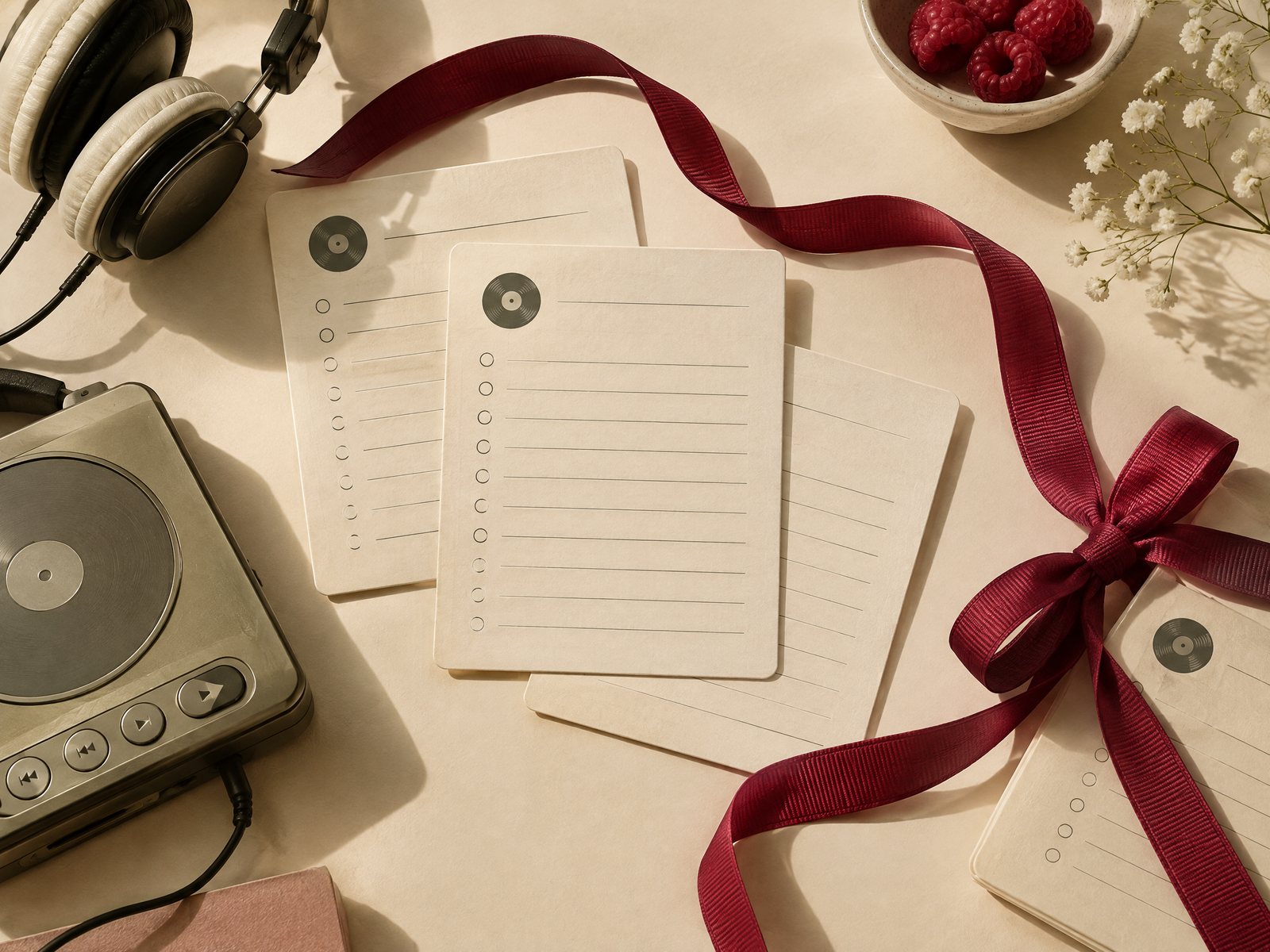
For a modular format, browse the Note Cards collection and look for a surface that supports short entries. The [Starry Clouds Note Cards | Kawaii Aesthetic Stationery Index Note Cards](/products/starry-clouds-note-cards-kawaii) is an actual catalog option: a bundle of 50 cards measuring 3 x 5 inches, printed on 14 pt. matte paper, with one lined side and one unlined side. Use the lined side for track references and the blank side for a small sketch, color cue, or personal note. The catalog describes the stock as resisting bleed-through, but test your own pen if the handwriting matters.
A music-adjacent visual can act as a quiet signpost without turning the gift into a merchandise bundle. The [Sunset Music Player Cute Aesthetic Bookmark](/products/sunset-music-player-cute-aesthetic) is listed as a 2 x 6 inch, double-sided glossy cardstock bookmark with rounded corners. Tuck it into the envelope as the “start here” marker, or use it to point toward the first card. It is a catalog selection, not a claim that Farouk manufactured every design represented in the shop.
For a small decorative accent, the [Blooming Records Sticky Notes](/products/blooming-records-sticky-notes) are listed as a 3 x 3 inch pad of 50 adhesive sheets. Use one as a removable divider for “side A” and “side B,” or write a brief listening question that the recipient can move beside the card they are considering. Keep the note optional. Adhesive decoration should not become a condition of enjoying the playlist.
You can also pair the cards with a note card or stationery gift selection only when the format serves the plan. Before requesting an item, review the current listing. The site bag prepares an email order request rather than a payment checkout, so inventory, taxes, and shipping need confirmation; do not treat a displayed price or availability as a promise.
A simple six-card architecture works well:
1. Cover card: Give the playlist a title that is yours, not a copied lyric or trademarked slogan. Add one sentence describing the occasion. 2. Listening card: Write where to find the playlist through the authorized service, leaving space for the recipient’s own link or access note. Do not print a downloaded file or unofficial copy. 3. Sequence card: List the first three tracks and artists, then explain why the opening order matters in your own words. 4. Middle card: Name the pivot—perhaps the point where the tempo, instrument, or subject changes. Describe what to notice, not what the listener must feel. 5. Memory card: Share one safe, concise context note. Replace a private name or location with a neutral phrase if the card may be handled by others. 6. Response card: Invite a low-pressure reply such as “Which transition stayed with you?” or “Where did you listen first?” A reply is welcome, not required.
This structure leaves the full track list in the streaming service and keeps the physical gift readable. If you need more room, make a second sequence card rather than shrinking your handwriting until the details become difficult to use.
Write context without copying protected material
The strongest notes explain your selection process. For each chosen track, answer one of four questions: What scene does it belong to? What changed when you placed it next to the previous song? What personal association can you share safely? Why might this be a good stopping point? These prompts produce original commentary without asking you to reproduce lyrics or a recording.
Try specific language:
- “I placed this second because its quieter opening gives the first track somewhere to land.”
- “This is the song I played while sorting old photographs; the association is mine, so take or leave it.”
- “Pause here if you want the next section to feel like a fresh start.”
- “I included this for the bass line and the change in pace, not because the words describe your life.”
That last distinction matters. Do not assign a song’s meaning to another person or imply that a playlist is a substitute for support, treatment, or professional advice. Music can be part of an ordinary gift, but the recipient should remain free to dislike a selection, skip a track, or hear it differently.
Copyright questions are easiest to manage when you keep the paper original. Write song titles and credited artist names as identification, but do not copy verses, choruses, long quotations, or album artwork. If you want to include a scannable route to the playlist, generate it from the authorized service you use and verify it before gifting; otherwise leave a short blank labeled “playlist link” for you to add after confirming the recipient’s preferred platform. A written service name and playlist title may be enough to find it without making the card a reproduction of the music.
Avoid the temptation to use a lyric as the card’s headline because it seems efficient. Replace it with a description of your intention: “songs for the walk home after a long week” communicates the occasion while keeping the wording yours. If a title itself is ambiguous, add the artist so the recipient can identify the correct recording.
Assemble, test, and adjust the finished gesture
Lay the cards out in order before putting them into an envelope. Read them as if you had never heard the playlist. Can you tell what the gift is for? Is the first listening action obvious? Does any sentence reveal someone else’s private information? Are the artist names and track titles legible? This five-minute test catches more problems than adding another decoration.
Then test the link or finding instructions on the device the recipient is likely to use. Check that the playlist is shared with the intended audience and that the title is searchable. If a service account makes the list private, do not assume a recipient can open it. You can simply write, “Search this title in [service name],” and provide the creator name, or send the access details separately through a private channel.
Consider the physical handoff. A card set for a birthday can sit inside a larger envelope with the bookmark as a visible marker. A friendship gesture may be better as a single folded note with three highlighted tracks, so it does not look like an obligation. For a long-distance recipient, photograph the cards only if they have agreed to that kind of sharing; a physical keepsake does not need a public post to be meaningful.
Watch for four common misfires:
- The playlist is too long. Make a “first listen” cut of five to eight tracks and mention that the larger queue is optional.
- The notes sound like instructions. Change “You will love this” to “I noticed this when I heard it; tell me if it lands differently.”
- The card reveals more than intended. Remove names, dates, or places that belong to another person, and keep a neutral version of the memory.
- The design competes with the message. Remove extra stickers or dividers until the track references and context can be read at a glance. The About page is the right place to learn about the shop; the playlist card should stay focused on your recipient.
Before making a final request, confirm the current product details and your preferred combination. Farouk Book Store is a shop with an editorial selection, so treat the listed designs as materials you are choosing for this project, not as a claim that the store made every catalog item. A personal playlist paper gift succeeds when the recipient can understand the invitation, find the music through a legitimate route, and add their own meaning. Let the cards hold the story around the songs—and let the songs remain theirs to hear in their own way.
Related reading: See Why Handwritten Greeting Cards Still Matter, How to Build a Personalized Gift Bundle, and Why Small Gifts Create Big Connections.